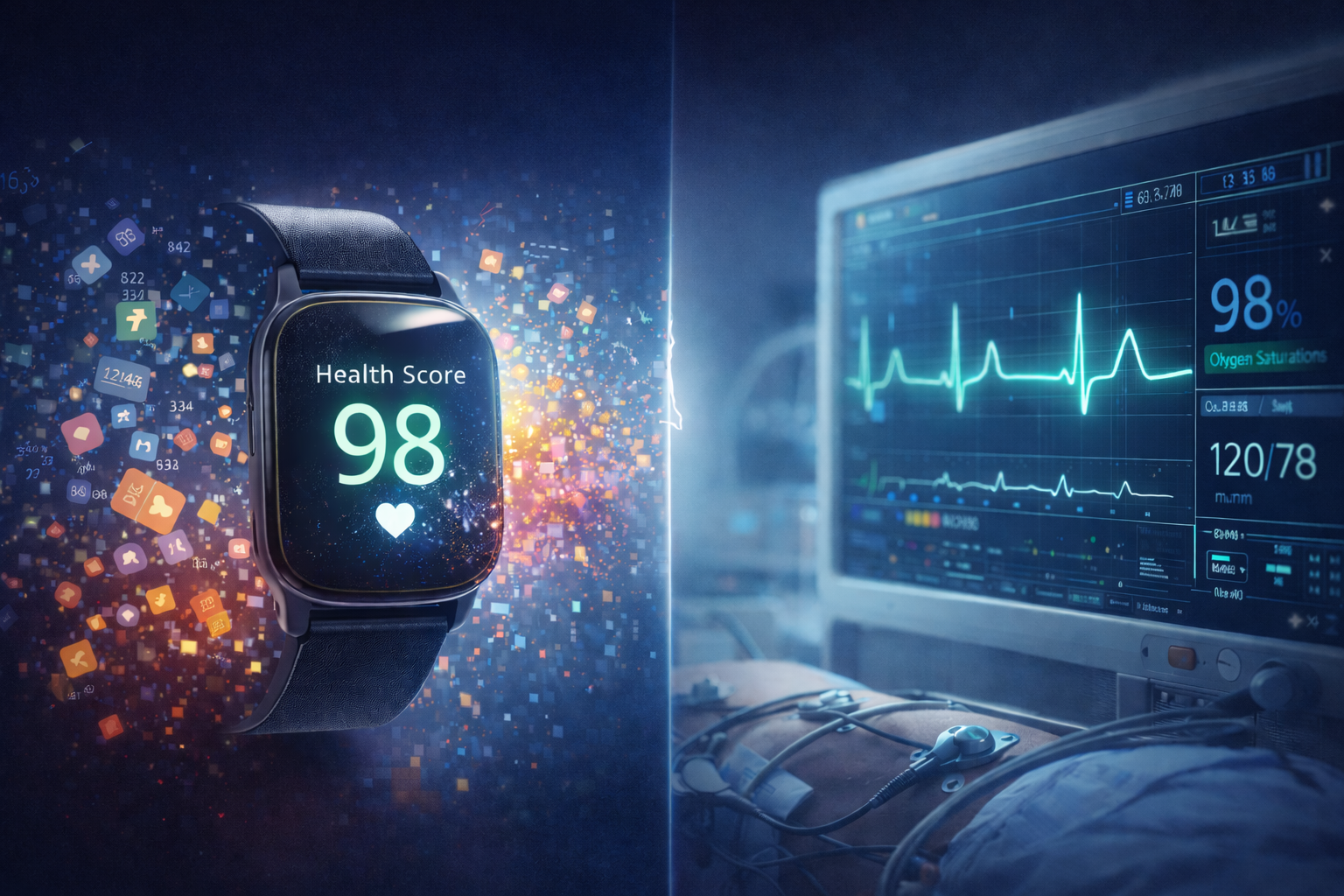
The wearable market loves to confuse motion with progress.
Every year, more devices appear. More sensors, more "health scores," more dashboards, more claims. But most wearables will never be clinical—not because sensors are useless, but because "consumer wearable" and "clinical tool" are different species with different survival requirements.
A consumer wearable is optimized for engagement: habit loops, streaks, motivation, lifestyle nudges. Clinical care is optimized for decisions: triage, documentation, escalation, accountability, and outcomes. One is trying to get you to open an app. The other is trying to prevent deterioration without drowning clinicians in noise.
That mismatch shows up in published research in a way that's easy to miss if you only read marketing. Wearable ECG/PPG devices can be impressive for screening and detection, but real-world limitations matter: many algorithms are narrow (e.g., built to separate AF from sinus rhythm) and can generate false positives or miss other rhythms in the presence of ectopy, flutter, or competing signals. PMC
Even when accuracy is strong on paper, "clinical usefulness" still depends on context: who reviews the alert, how it's confirmed, what actions follow, how it's documented, and how often the system is wrong in the real population it's deployed into. Professional summaries in cardiology note high sensitivity/specificity reported in meta-analyses for AF detection, but that's still just one clinical use-case—and it doesn't automatically translate into end-to-end clinical workflow value. American College of Cardiology
So what makes something truly clinical?
Not vibes. Not UI polish. Not "we measure 47 biomarkers."
Clinical-grade tools behave like boring infrastructure:
- they map to a care pathway (what's monitored, why, what triggers action)
- they reduce ambiguity rather than increase it
- they integrate with clinical review and documentation
- they minimize alert fatigue and liability-shaped noise
Most wearables are not built for that. They're built to sell to individuals, not to serve care teams. That's why the industry keeps producing devices that are impressive in a demo and irrelevant in a ward round.
The wearables that matter clinically won't win by adding more metrics. They'll win by fitting into care delivery with ruthless practicality—turning signals into decisions, not curiosity.