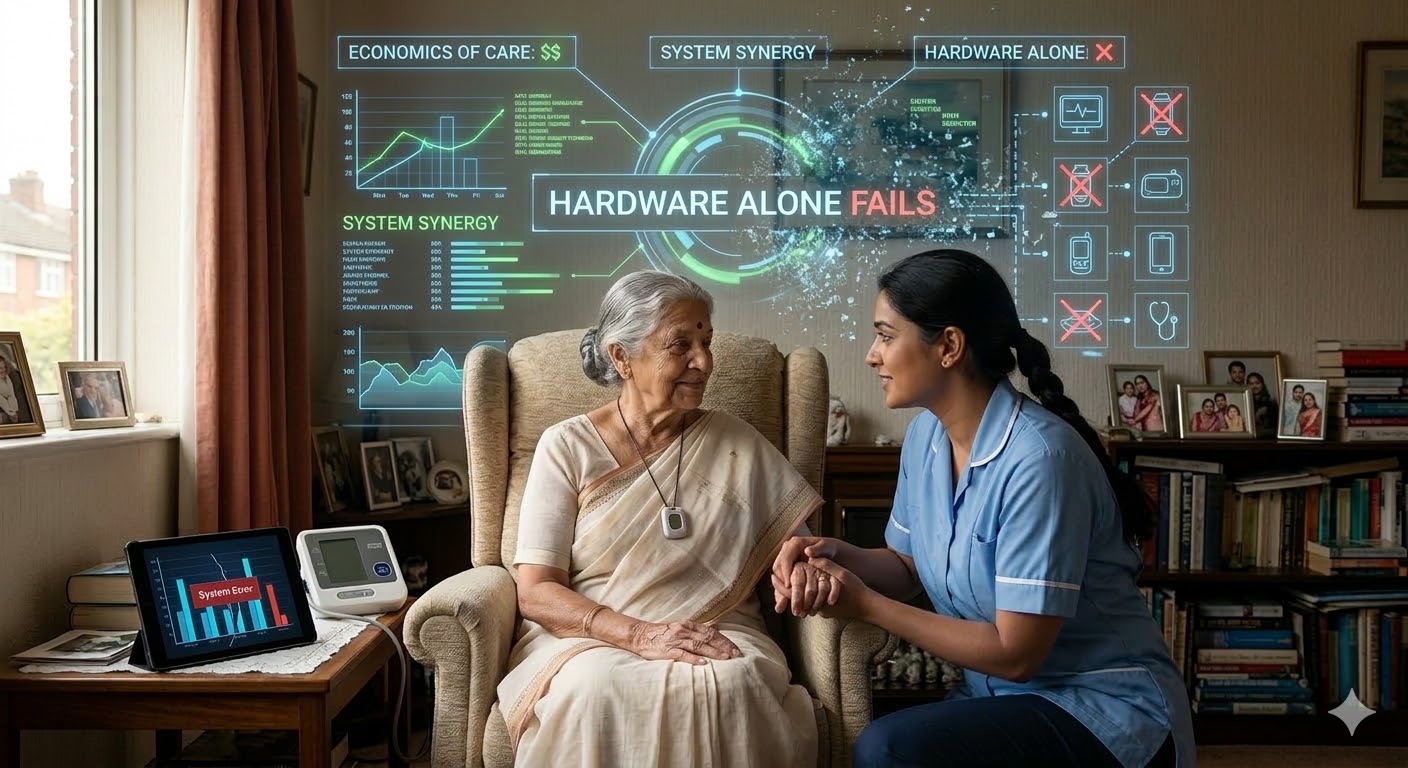
There's a recurring fantasy in health tech: build a nice device, sell enough units, and the business will take care of itself.
Usually it won't.
Hardware-only strategies in healthcare are fragile. Devices get copied, components commoditize, margins compress, and service/integration costs quietly eat you alive. Meanwhile, clinical adoption moves at healthcare speed, not consumer electronics speed.
Continuous care makes this even more obvious.
In RPM, the device is the front door—not the whole building. The economics live in everything around it:
- onboarding and adherence
- monitoring logic and alert governance
- clinical review workflows
- integration into care delivery systems
- service reliability
- longitudinal data continuity
- proof of outcomes
Published evidence reinforces this: RPM programs that show benefit often include more than passive measurement—education, self-management support, communication loops, and structured interventions are frequently part of what makes outcomes move. PMC
That's the punchline: the "value" is usually in the system, not the sensor.
Which means defensibility comes from platform depth:
- workflow integration
- clinical intelligence
- multi-setting deployability (home, post-discharge, eldercare, hospitals)
- consistent service and support
- outcomes measurement and reporting
Hardware without a platform becomes a low-margin product business competing on price. Hardware with a platform becomes infrastructure—harder to replace, easier to scale, and capable of compounding value over time.
So the future of continuous care won't be owned by the company with the prettiest band. It'll be owned by the company that can reliably turn continuous signals into clinical action—and prove that action improves outcomes and unit economics.
That's the game. Everything else is gadget theater.