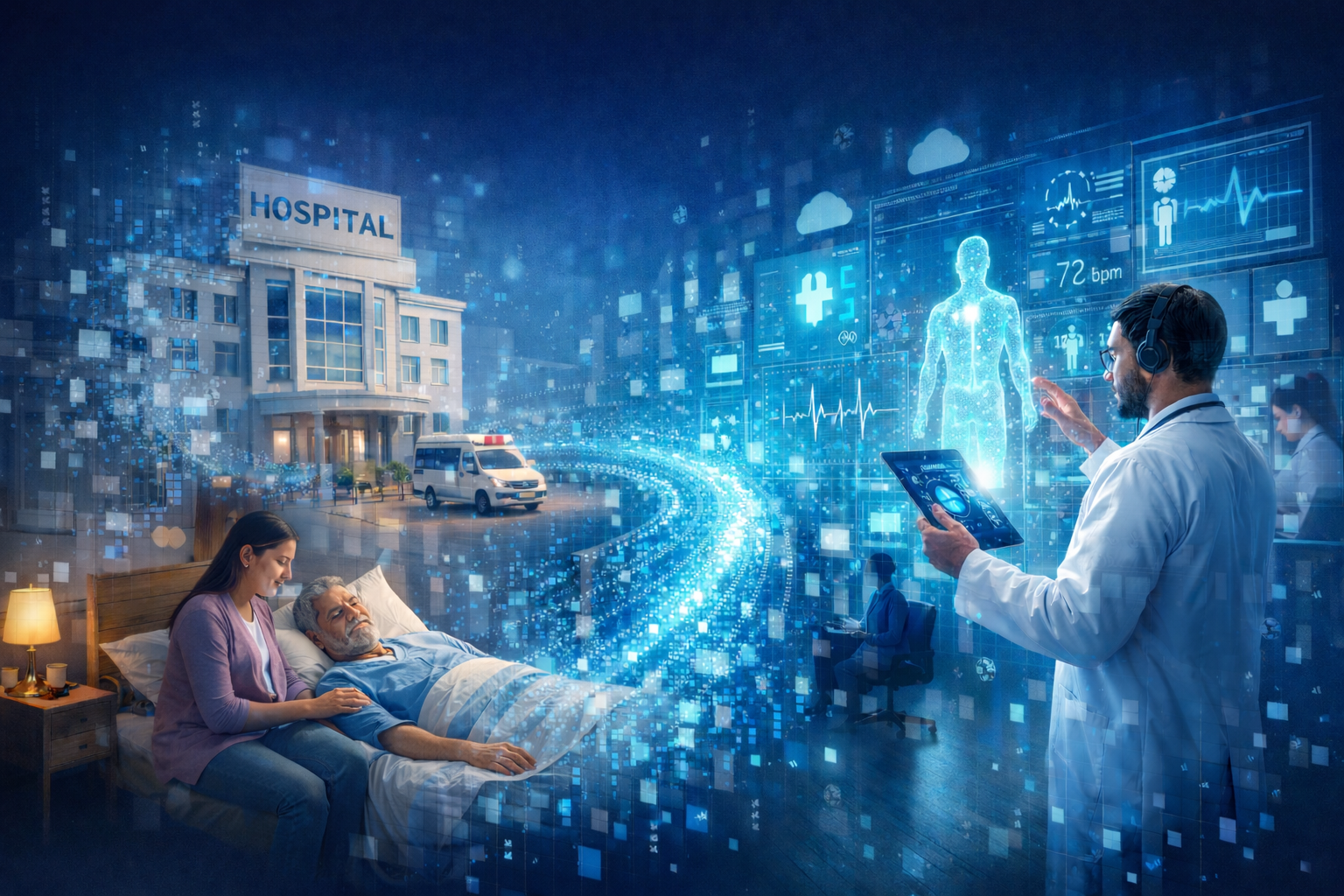
For most of modern medicine, the hospital was the center of gravity. If something went wrong, the patient came in, got assessed, treated, discharged, and then disappeared from view until the next visit. Care was episodic.
That model is getting old—not because hospitals are unimportant (they're essential), but because a growing share of illness doesn't behave in neat hospital-friendly episodes. Diabetes, hypertension, COPD, post-operative recovery, frailty in older adults, heart failure—these are continuous stories. If care stays episodic while disease is continuous, the system ends up reacting late, and paying for that lateness.
The deeper shift is this: healthcare is moving from place-based intervention to time-based visibility.
And this isn't philosophical fluff. Published clinical research repeatedly shows that patient deterioration often has detectable signatures before it becomes an emergency—especially when you look at trends and patterns rather than isolated readings. Work on inpatient deterioration and ward monitoring shows that different deterioration pathways (respiratory instability, sepsis, heart failure escalation) have distinct "signatures," and models and monitoring designed to capture those patterns can improve prediction. PMC
Even more bluntly: continuous or higher-frequency monitoring can surface earlier warning than periodic checks. One study on continuous monitoring systems reported earlier alerts (on average) before ICU transfer compared with intermittent monitoring. JMIR Another study comparing continuous vs periodic scoring notes that large measurement intervals can delay detection. Springer
Now zoom out from inside the hospital.
A lot of the most expensive events happen after discharge or outside institutional walls—exactly when the system is the least "aware." That's why remote monitoring keeps resurfacing as a serious infrastructure play: it is basically an attempt to extend clinical visibility into the messy parts of life where patients actually live.
But here's the trap:
collecting data is not the same as delivering care.
A stream of numbers doesn't help if nobody can interpret it fast enough, if it doesn't fit workflow, or if it's not tied to a response path. That's why the future isn't "wearables" as a fashion category. It's continuity: longitudinal monitoring, intelligent triage, and escalation that respects clinical attention as a scarce resource.
The hospital is still a place. But increasingly, it's also a decision layer sitting on top of a patient data stream—where care quality depends on how well you detect drift early and respond before drift becomes disaster.
That's not sci-fi. It's just where the evidence and economics point.